





Data-Backed Buyer’s Guide: Snow Tube vs. Sled: What’s The Difference? — 5 Factors for Speed, Safety & Fun
January 6, 2026
Abstract
The selection of winter recreational equipment, specifically between snow tubes and sleds, presents a choice rooted in distinct principles of design, safety, and user experience. This analysis examines the fundamental differences between these two popular forms of snow-sliding apparatus. It evaluates them across five primary dimensions: speed and aerodynamics, rider control and steering, safety profiles and risk factors, material science and durability, and overall cost-effectiveness and value. Snow tubes, typically inflatable devices made from PVC or vinyl, often with a fabric cover, prioritize speed and a cushioned ride by minimizing surface friction. Sleds, which encompass a wide array of designs from plastic saucers to steerable toboggans, generally offer greater rider agency through directional control. This examination synthesizes technical specifications, material properties, and principles of physics to provide a comprehensive framework for understanding the Snow Tube vs. Sled: What's The Difference? dilemma, enabling users to make an informed decision based on intended use, risk tolerance, and desired recreational outcome.
Key Takeaways
- Tubes generally offer higher speeds due to less friction with the snow.
- Sleds provide superior steering and control, enhancing rider agency.
- The Snow Tube vs. Sled: What's The Difference? choice often balances thrill against control.
- Material durability varies widely, from thin plastic sleds to robust PVC snow tubes.
- Safety depends on both the device's design and the user's responsible operation.
- Consider the primary user—child, adult, or family—when making a selection.
- Hard-bottom tubes combine the speed of tubing with the durability of a sled.
Table of Contents
- A Foundational Question: Design Philosophy and User Experience
- Factor 1: The Dynamics of Speed and the Pursuit of Velocity
- Factor 2: The Question of Agency—Steering, Control, and Braking
- Factor 3: A Nuanced Examination of Safety and Risk
- Factor 4: Material Science, Durability, and the Test of Time
- Factor 5: Economic Considerations, Versatility, and Long-Term Value
- Making an Informed Choice for Your Winter Adventures
- Frequently Asked Questions (FAQ)
- Final Reflections on the Descent
- References
A Foundational Question: Design Philosophy and User Experience
When a fresh blanket of snow transforms the landscape, the human impulse for play awakens a familiar debate on the hillside: the choice between a snow tube and a sled. This is not merely a decision between two objects, but an alignment with two differing philosophies of descent. To truly grasp the "Snow Tube vs. Sled: What's The Difference?" question, we must first look past the materials and shapes to the experience each is engineered to provide. It is a choice between surrendering to the hill's contours and actively commanding one's path down its face.
What is a Snow Tube? A Cushion of Air
Imagine the simplest way to glide over a surface: by floating. A snow tube is, in essence, a captured pocket of air, a buoyant vessel for the snow. Its fundamental design is a torus, or donut shape, made of a flexible, airtight material like polyvinyl chloride (PVC) or vinyl. This inflatable nature serves two purposes. First, it creates a cushion, absorbing minor bumps and imperfections in the terrain, which can make for a smoother ride. Second, and more pertinent to its function, the smooth, taut surface of an inflated tube, when in contact with snow, creates exceptionally low friction. The rider sits within the center, their weight distributed around the ring. This design minimizes the contact patch and presents a rounded, almost liquid-like profile to the snow, encouraging speed above all else. More advanced models, such as those seen at commercial tubing parks, may feature a smooth, hard plastic bottom to further reduce friction and enhance durability (Snow Sleds Direct, n.d.).
What is a Sled? A Legacy of Form
The sled, by contrast, is a vessel of structure and form. Its lineage is ancient, stretching back to utilitarian tools for transporting goods over snow. Modern recreational sleds inherit this principle of a rigid or semi-rigid body designed to slide. The variety is immense, a testament to generations of innovation. We have the simple plastic saucer, a concave disc that spins and slides with wild abandon. There are toboggans, long and flat-bottomed, designed to hold multiple riders and follow a relatively straight path. Then there are more complex sleds with runners—thin blades of metal or plastic that, like ice skates, concentrate the sled's weight onto a very small surface area to reduce friction and increase speed. Many modern plastic sleds incorporate molded runners and even steering mechanisms connected to handles, giving the rider a degree of control over their direction. The experience of sledding is therefore defined by the shape and features of the sled itself.
The Initial Point of Divergence: Design Philosophy
Here lies the heart of the matter. The snow tube is an instrument of submission; you entrust your descent to physics, becoming a passenger on a cushion of air. The joy comes from the speed, the spinning, the exhilarating lack of control. It is a partnership with gravity and the hill. The sled is an instrument of agency. Even the simplest saucer, which can be influenced by leaning, or the most advanced steerable toboggan, asks the rider to be a pilot. The joy is found in carving a turn, in dodging an obstacle, in guiding the craft to a chosen destination.
Therefore, the question "Snow Tube vs. Sled: What's The Difference?" is not just about material or shape. It is about the kind of relationship you wish to have with the hill. Do you want to be a freewheeling passenger or an engaged pilot? Your answer to that question will guide you through the more technical comparisons that follow.
Factor 1: The Dynamics of Speed and the Pursuit of Velocity
The sensation of speed is a primary motivator for many winter enthusiasts. The rush of wind, the blur of the landscape—it is a thrilling reward for the trek back up the hill. When evaluating the snow tube against the sled, the physics of speed, friction, and aerodynamics become central to the discussion. While many variables exist, certain design principles give one an inherent advantage over the other in the pure quest for velocity.
The Tube's Advantage: Minimizing Friction
A snow tube is a master of minimizing friction. Think of how a puck glides across an air hockey table. The tube achieves a similar, albeit less perfect, effect on snow. Its inflated, non-porous surface has very few microscopic imperfections to catch on the snow crystals. The circular shape means that as it spins—which it almost invariably does—there is no single "leading edge" to plow through the snow and create resistance.
Furthermore, the rider's weight is distributed across the entire circumference of the tube. This pressure, combined with the motion, can melt a razor-thin layer of snow beneath it, creating a lubricating film of water that allows the tube to slide with even greater efficiency. Commercial-grade and heavy-duty snow tubes often take this a step further by incorporating a slick polyethylene (PE) or ABS plastic hard bottom. This rigid surface is even smoother than the PVC itself, reducing the coefficient of friction to its lowest possible value and turning the tube into a veritable downhill accelerator.
The Sled's Equation: Surface Area and Material
A sled's speed is a more complex equation. The material and shape are paramount. A traditional wooden toboggan has a large, flat surface area. While smooth, this large contact patch can create more friction than a tube, especially in soft, deep snow where it has to plow its way forward.
Plastic sleds, the most common type today, attempt to solve this with design. Many feature "runners"—raised channels on the underside. These are meant to mimic the runners of a classic metal-runner sled. The idea is to reduce the surface area in contact with the snow, concentrating the rider's weight onto these thin lines. This reduces friction and allows the sled to "track" in a straight line more effectively. However, the effectiveness of these molded plastic runners can be limited compared to the sharp, narrow runners of a true metal-railed sled.
A simple, flat-bottomed plastic sled or a saucer disc often has the highest friction of all, as its entire bottom surface drags against the snow. Their speed is often generated more by steepness of the hill than by the efficiency of their design.
Hill Conditions: The Great Equalizer?
The type of snow plays a significant role.
- Light, Powdery Snow: In deep, fluffy powder, a sled can get bogged down. Its defined edges have to push a lot of snow out of the way. A tube, with its rounded shape, may "float" on top more effectively and maintain its speed.
- Packed, Icy Snow: On a hard, icy surface, the tables can turn. Friction is already very low for any object. Here, a sled with good runners can be exceptionally fast, as it cuts a clean path. A tube is also extremely fast on ice, but it becomes even more uncontrollable, bouncing and skittering over every imperfection.
A Tale of Two Descents: A Thought Experiment
Imagine two identical twins of the same weight at the top of a moderately steep, well-packed hill. One has a high-quality, hard-bottomed snow tube. The other has a standard plastic toboggan-style sled.
They push off at the same moment. Initially, their acceleration is similar. But as they gain momentum, the tube's superior friction-reducing design begins to show. It pulls ahead, its round shape gliding effortlessly. The sled, while moving fast, is still contending with the friction of its larger surface area. The tube reaches the bottom of the hill several seconds before the sled, spinning to a slow stop in the run-out area. The sled rider, having used their hands to drag in the snow for a bit of braking, comes to a more controlled stop a moment later. In this typical scenario, speed belongs to the tube.
Factor 2: The Question of Agency—Steering, Control, and Braking
Beyond the raw thrill of speed, the experience of a downhill ride is profoundly shaped by the degree of control a rider can exert. This is perhaps the most significant functional divergence in the "Snow Tube vs. Sled: What's The Difference?" debate. It concerns the concept of rider agency—the ability to influence one's path, avoid obstacles, and stop safely. Snow tubes and sleds occupy nearly opposite ends of this spectrum.
The Unpredictable Joy of Tubing
Riding a snow tube is an exercise in letting go. Once you launch, your journey is largely in the hands of gravity and the subtle contours of the hill. Steering is minimal to non-existent. A rider can attempt to influence their path by leaning dramatically or dragging a hand or foot, but these actions are often ineffective and can destabilize the tube, increasing the risk of falling off. The tube's natural tendency to spin means you will likely face every direction—forwards, backwards, and sideways—during a single descent.
There are no built-in braking systems. The only way to stop is to wait for the tube to lose momentum on a flat run-out area or to attempt the risky maneuver of dragging your feet, which can lead to injury or being thrown from the tube. This lack of control is part of the appeal for thrill-seekers. The unpredictability is the point. You are not piloting a craft; you are riding a bubble down a mountain.
The Directed Path of the Sled
Sleds, in contrast, are almost all designed with some measure of control in mind. Even the most basic models can be influenced.
- Saucer Sleds: While prone to spinning like a tube, a rider can shift their weight and drag their hands to influence the spin and direction, providing a rudimentary form of steering.
- Toboggan Sleds: These long, narrow sleds are designed to track straight. Leaning heavily to one side can create a gentle, carving turn. Riders can also use their hands to drag in the snow on one side to initiate a turn or to brake.
- Steerable Sleds: This is where sleds truly shine. Many modern plastic and metal-runner sleds feature dedicated steering mechanisms. These can range from simple handles that turn the front portion of the sled to a full steering wheel that controls a set of front skis. These systems provide a significant degree of control, allowing a rider to navigate paths, avoid other people or obstacles, and actively engage with the hill. Many of these sleds also incorporate a hand-brake, a lever that digs a set of claws or a brake pad into the snow for effective stopping power.
A Comparison Table: Control Features
To clarify these differences, consider the following breakdown of control-related features.
| Feature | Typical Snow Tube | Basic Plastic Sled (Saucer/Toboggan) | Steerable Sled |
|---|---|---|---|
| Steering Mechanism | None | Rider leaning; hand dragging | Handles or steering wheel |
| Directional Stability | Low (prone to spinning) | Moderate (toboggans) to Low (saucers) | High (tracks straight) |
| Braking System | None (requires foot dragging) | Rudimentary (hand/foot dragging) | Often includes a dedicated hand-brake |
| Obstacle Avoidance | Very Difficult | Possible with effort | Effective and intuitive |
| Rider Agency | Passive Passenger | Active Participant | Engaged Pilot |
This table illustrates the clear trade-off. The snow tube exchanges nearly all rider agency for a cushioned, high-speed, and unpredictable ride. The sled, particularly a steerable model, sacrifices some of the wild chaos for the satisfying ability to command one's own descent. Your preference between these two modes of experience is fundamental to choosing the right equipment.
Factor 3: A Nuanced Examination of Safety and Risk
When families head to the hills, safety is a paramount concern. The discussion of "Snow Tube vs. Sled: What's The Difference?" must therefore include a sober assessment of the risks associated with each. It is not as simple as declaring one safer than the other; rather, they present different types of hazards. Understanding these distinct risk profiles is key to mitigating them and ensuring a fun, injury-free day.
Bumps, Bounces, and Braking: The Tube's Safety Profile
The primary safety advantage of a snow tube is its inflatable nature. The air-filled chamber acts as a natural shock absorber. When gliding over smaller bumps, moguls, or uneven terrain, the tube flexes and cushions the impact, protecting the rider's spine and body from jarring forces. This can make for a more comfortable ride and reduce the risk of compression-related injuries.
However, this advantage is paired with a significant safety liability: the almost complete lack of control. As discussed, a tube cannot be effectively steered or stopped. This places the rider at the mercy of the hill. If the path leads toward a tree, a patch of rocks, a road, or a crowd of people, the rider has no reliable way to alter their course. The high speeds that tubes can achieve exacerbate this danger. A collision at high speed can be catastrophic, and the tube itself offers little in the way of impact protection from a frontal collision with a hard object. Furthermore, the tendency to be thrown from a tube during a particularly violent bounce or an attempt to brake with one's feet introduces the risk of tumbling injuries.
Steering to Safety: The Sled's Defensive Edge
The primary safety advantage of a sled is control. The ability to steer is a powerful defensive tool. A vigilant rider on a steerable sled can actively scan the path ahead and make course corrections to avoid hazards. This capacity for obstacle avoidance dramatically reduces the risk of collision, which is a leading cause of serious sledding injuries. Many sleds also have brakes, giving the rider the ability to control their speed on steep sections or to come to a complete stop when necessary.
The trade-off is the sled's rigid construction. A sled does not absorb bumps in the same way a tube does. Hitting an unexpected mogul on a hard plastic or wooden sled can send a significant jolt through the rider's body. In a fall, landing on the hard sled itself can cause injury. While runners help a sled track straight, catching an edge on an icy patch can cause a sled to flip or veer suddenly. The sled's materials offer more abrasion resistance than a tube, but they provide no cushioning in a crash.
A Comparative Risk Assessment Table
| Risk Factor | Snow Tube | Sled | Mitigation Strategy |
|---|---|---|---|
| Collision with Obstacles | High Risk (due to lack of steering) | Lower Risk (if steerable) | Choose open, obstacle-free hills. |
| Loss of Control | Very High Risk (inherent to design) | Moderate Risk (depends on sled type/skill) | Use equipment appropriate for skill level. |
| Impact from Bumps | Low Risk (cushioning effect) | High Risk (rigid body) | Survey the hill for large bumps before riding. |
| Falling Off Equipment | Moderate to High Risk | Moderate Risk | Ride in a safe, seated position, facing forward. |
| Inability to Stop | Very High Risk | Lower Risk (if equipped with brakes) | Ensure there is a long, flat run-out area. |
The Human Factor: Responsible Winter Fun
Ultimately, the most significant safety factor is not the equipment but the user's judgment. No sled or tube is safe on an inappropriate hill. Key safety practices include:
- Choosing the Right Venue: Select hills that are free of trees, fences, rocks, and other obstacles. The hill must end in a long, flat run-out area, far away from any streets or parking lots.
- Wearing a Helmet: Particularly for children, a well-fitted winter sports helmet can prevent serious head injuries.
- Riding Position: Always ride sitting up and facing forward. Lying down headfirst dramatically increases the risk of a head or spinal injury.
- Hill Traffic: Establish clear paths for riding down and walking back up. Never stop in the middle of a sledding path.
In the end, the safety debate between a tube and a sled is a debate between two types of risk: the risk of an unguided collision (tube) versus the risk of a jarring ride and the potential for flipping (sled). A steerable sled in the hands of a responsible rider on a clear hill is arguably the safer option due to the element of control.
Factor 4: Material Science, Durability, and the Test of Time
When you purchase a piece of winter recreation equipment, you are making an investment in future fun. Its durability—how well it stands up to the cold, the friction, and the occasional impact—is a major part of its overall value. The materials used in the construction of snow tubes and sleds are fundamentally different, leading to distinct lifespans, failure points, and maintenance needs.
The Anatomy of a Modern Snow Tube
A snow tube is a composite of several materials working in concert.
- The Inner Bladder: The heart of the tube is the component that holds the air. In less expensive models, the outer shell itself is the bladder, typically made of a single layer of PVC. In higher-quality tubes, there is a separate inner bladder, much like a truck tire's inner tube, made of black butyl rubber. This rubber is more resilient and less prone to cracking in the cold than simple PVC.
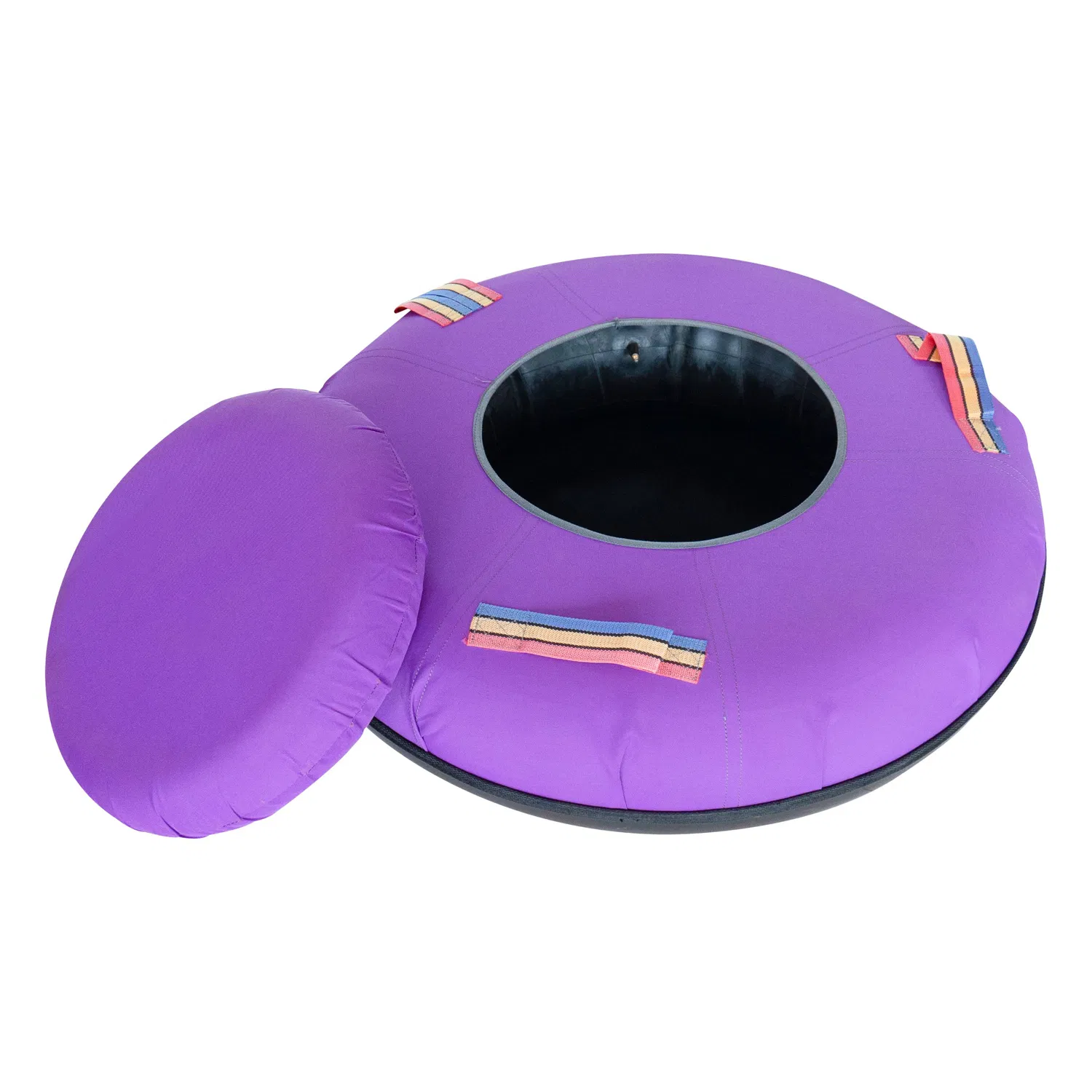
- The Cover: Many recreational tubes feature a fabric cover that encases the inner bladder. This cover serves multiple functions. It protects the bladder from punctures and abrasions, provides a more comfortable seating surface, and is where the handles and tow rope are securely stitched. The cover is often made of a durable nylon or polyester canvas, similar to what you might find on a backpack. The bottom of the cover is usually a different material—a slick, heavy-duty tarpaulin or a thin layer of plastic to enhance sliding.
- The Bottom: The most significant evolution in tube technology is the hard-bottom shell. As seen in , a rigid polyethylene (PE) plastic base is attached to the bottom. This transforms the tube. The hard bottom is incredibly durable, resisting punctures from sharp ice or hidden rocks. It also provides the fastest possible sliding surface. Many premium consumer models now adopt this feature, blending the comfort of a tube with the durability of a sled. High-quality PVC snow tubes offer a balance of affordability and resilience, with manufacturers often specifying the thickness of the PVC (e.g., 0.6mm) as an indicator of toughness (Accio, 2025).
The primary failure point for a tube is a puncture. A sharp rock, a stick hiding under the snow, or even a sharp piece of ice can pierce the bladder, rendering the tube useless until patched.
The Spectrum of Sled Materials
Sleds are crafted from a wider variety of materials, each with its own durability profile.
- Plastic: The vast majority of modern sleds are made from plastic, usually high-density polyethylene (HDPE). This material offers a good balance of slickness, flexibility, and cost. However, its durability is highly dependent on thickness and temperature. Thin, cheap plastic saucers can become brittle in extreme cold and crack easily upon impact. Thicker, well-engineered plastic sleds can withstand years of use.
- Foam: Some sleds are constructed from a dense foam core, similar to a boogie board, with a slick plastic bottom. These are lightweight and offer some cushioning, but the foam can be gouged or torn, and the plastic bottom can delaminate over time.
- Wood: The classic toboggan is made of steamed and bent wood planks. Wood is strong and has a timeless aesthetic. With proper care (like waxing the bottom and storing it in a dry place), a wooden sled can last for generations. Its main vulnerabilities are rot if stored wet and cracking from a severe impact.
- Metal: Metal-runner sleds, often with a wooden deck, were once the standard. The steel runners are exceptionally durable and fast on hard snow. Their weak points are rust if not dried properly and the potential for the wooden steering components to break.
The failure point of a sled is typically a catastrophic crack or break, which is often unrepairable.
Longevity and Maintenance: An Investment Perspective
From a longevity standpoint, the comparison is nuanced. A cheap, thin-walled plastic sled might only last a single season before cracking. A cheap, thin-gauge PVC tube might suffer a puncture on its first day.
Conversely, a high-quality, hard-bottom snow tube is an extremely durable piece of equipment. Its most vulnerable part, the inner bladder, is protected by both a canvas cover and a hard shell. Even if it does get a puncture, it can often be patched.
A well-made wooden or thick plastic sled can also offer many years of service. Its maintenance is simpler—just wipe it dry and store it away from extreme temperature swings. A tube requires deflation for storage, which takes time, and care must be taken not to store it near sharp objects.
If you are seeking maximum durability, the choice is between a premium hard-bottom tube and a high-quality sled made of thick plastic or wood. The cheapest options for both tubes and sleds should be viewed as semi-disposable.
Factor 5: Economic Considerations, Versatility, and Long-Term Value
A day of winter fun should not require a major financial outlay. The cost of equipment is a practical and important factor in the "Snow Tube vs. Sled: What's The Difference?" equation. Examining the initial price, potential for multi-season use, and overall value proposition reveals the economic character of each option.
Initial Investment: A Price Point Analysis
There is a wide range of prices within both categories, but general tiers can be identified.
- Entry-Level (Under $30): This tier is dominated by simple, thin plastic saucer or toboggan sleds and basic, single-layer PVC snow tubes without a cover. These are widely available at big-box retailers. While affordable, their durability is questionable, and they may not last more than a season or two of moderate use.
- Mid-Range ($30 – $80): Here you find better quality equipment. This includes thicker, more robust plastic sleds, some with basic steering, and snow tubes with durable canvas covers and more resilient inner bladders. Foam sleds also fall into this category (Sunlite Sports, n.d.). For many families, this price point represents the sweet spot between affordability and performance.
- Premium ($80 and above): This level includes high-end, steerable sleds with advanced braking systems and metal components, as well as heavy-duty snow tubes with hard plastic bottoms. These items are built for performance and longevity. A commercial-grade, multi-person snow tube can cost several hundred dollars but offers unparalleled durability (GoSports, n.d.).
Generally, at the lowest price points, sleds are often cheaper than tubes. A very basic sled can be found for less than a very basic tube. However, in the mid and premium ranges, the prices become quite comparable. A good steerable sled might cost the same as a good hard-bottom tube.
Beyond the Hill: Multi-Use Potential and Storage
Versatility can add to an item's long-term value. Here, the snow tube has a unique advantage. Many snow tubes, especially those with durable covers, are also designed to be used as river or lake floats in the summer. An item that can be used for both winter sledding and summer floating offers twice the value for a single purchase. Sleds, by their very nature, are single-purpose items.
Storage is another practical consideration. An inflatable snow tube, once deflated, can be folded or rolled into a compact size, taking up minimal space in a closet or garage. A sled, being rigid, requires more storage space. A long toboggan or a bulky steerable sled can be awkward to store. For those with limited space, the storability of a tube is a significant benefit.
The Value Proposition: Cost-Per-Thrill
Ultimately, value is a personal calculation. What is the "cost-per-thrill"?
- The Sled's Value: The value of a sled, particularly a steerable one, lies in its re-playability and the skill it fosters. A child can spend an entire afternoon mastering a turn or navigating a specific path. This engaging, active play can provide hours of entertainment. A durable sled that lasts for five years provides a very low cost-per-use.
- The Tube's Value: The value of a tube is in the high-octane, low-effort thrill it provides. It is pure, simple fun that requires no skill. Its potential for summer use adds a significant dimension to its value. A high-quality tube that serves both winter and summer recreation needs for several years is an excellent investment.
When considering cost, think beyond the initial price tag. Factor in durability, versatility, and the type of play experience you are seeking. A slightly more expensive but durable and versatile item will almost always provide better long-term value than the cheapest option on the shelf.
Making an Informed Choice for Your Winter Adventures
Having examined the core differences in design, speed, control, safety, materials, and cost, we can now synthesize this information into practical recommendations. The right choice in the "Snow Tube vs. Sled: What's The Difference?" dilemma depends entirely on who you are and what you seek from a day in the snow.
For the Thrill-Seeking Family
If your family craves speed, laughter, and the chaotic joy of a spinning, bouncing descent, the snow tube is your ideal companion. The experience is passive and shared—everyone gets the same wild ride. Opt for a high-quality model with a durable cover and, if the budget allows, a hard bottom. These models, like the ones offered by many specialized retailers, provide the best combination of speed and longevity. A larger tube can often accommodate an adult and a small child together, making for a wonderful shared experience. The lack of control is part of the fun, but it demands that you choose your location with extreme care—a wide-open, gentle hill with a long, flat run-out is non-negotiable.
For the Cautious and Control-Oriented
If your priority is safety and you envision a day spent teaching your children how to navigate the slopes, a steerable sled is the superior choice. The ability to direct the sled and, in many cases, apply a brake, provides a sense of security and empowers the rider. This option turns sledding into a skill-based activity, encouraging active participation and problem-solving. It is an excellent tool for building confidence on the snow. Look for a model with a robust steering mechanism, an effective brake, and construction from thick, cold-resistant plastic. This is the choice for parents who want to be able to say "steer left!" and have it mean something.
For the Budget-Conscious Adventurer
If you are looking for the most affordable entry into snow-sliding fun, the classic, simple plastic sled is hard to beat. A basic toboggan or saucer can be purchased for a very low price and will provide plenty of entertainment. While it lacks the speed of a good tube or the control of a steerable sled, it represents the essence of the activity. Be aware of the trade-offs in durability—it may crack in the cold—but for occasional use or to test the waters of winter recreation, it is a perfectly valid and economical starting point. As your interest grows, you can then make a more significant investment in a higher-quality tube or sled.
Ultimately, there is no single "best" option. The perfect winter ride is the one that best matches your appetite for risk, your desire for control, and your vision of a perfect day in the snow.
Frequently Asked Questions (FAQ)
Which is faster on average, a snow tube or a sled?
On most typical snow conditions, a snow tube is faster. Its inflated, smooth surface creates less friction with the snow compared to the larger surface area of most sleds. High-quality tubes, especially those with hard plastic bottoms, are specifically designed to maximize speed by minimizing friction.
Are hard-bottom snow tubes better than regular ones?
Hard-bottom snow tubes are generally considered superior in terms of both speed and durability. The slick, rigid plastic bottom reduces friction even more than a standard fabric or PVC bottom, leading to faster rides. It also provides excellent protection against punctures from rocks or sharp ice, significantly extending the tube's lifespan.
Can adults use any type of sled or snow tube?
Not necessarily. It is vital to check the manufacturer's weight and size recommendations. Many inexpensive plastic sleds are designed for children and may crack under an adult's weight. Similarly, snow tubes come in various sizes. Adult riders should look for tubes with a diameter of at least 40-48 inches and a high weight capacity to ensure a safe and comfortable fit (WinterKids, n.d.).
How do I repair a punctured PVC snow tube?
Most PVC snow tubes can be repaired using a simple vinyl patch kit, similar to what is used for pool floats or air mattresses. The process involves cleaning the area around the puncture, applying a strong vinyl adhesive, and pressing a patch firmly over the hole. It is important to let the patch cure completely before re-inflating the tube.
Which is easier to carry up a hill, a sled or a snow tube?
This depends on the specific model. An inflatable snow tube is often lighter than a sled of a similar size. Most tubes also come with a tow rope, which makes pulling it back up the hill relatively easy. However, a very basic, small plastic sled can be lighter than a large, heavy-duty snow tube.
Are there multi-person options for both tubes and sleds?
Yes. Traditional toboggans are classic multi-person sleds, designed for two or more riders. In the world of tubing, you can find large-diameter tubes designed to hold two or more people, as well as novelty "double" tubes that are shaped like a figure-eight to provide separate seating areas for two riders.
Final Reflections on the Descent
The journey down a snow-covered hill, whether on a sled or a tube, is a brief but potent experience. It is a moment of release, a fleeting dance with gravity. The choice of vessel for this dance reflects a deeper personal preference. To choose a sled is to choose engagement, to become a pilot who reads the terrain and charts a course. It is an affirmation of agency. To choose a tube is to choose surrender, to become a passenger on a cushion of air, embracing the chaos and trusting the hill to deliver its thrill. There is no right or wrong answer in the "Snow Tube vs. Sled: What's The Difference?" deliberation, only a question of what kind of joy you seek.
References
Accio. (2025). Novelty design snow tubes: Durable & fun for kids and adults. Retrieved from
GoSports. (n.d.). Snow sports. Retrieved from
Snow Sleds Direct. (n.d.). Commercial snow tubes. Retrieved from
Snow Sleds Direct. (n.d.). Snow sleds. Retrieved from
Sunlite Sports. (n.d.). Snow fun. Retrieved from
Walmart. (n.d.). Sleds & snow tubes in winter sports. Retrieved from
WinterKids. (n.d.). Snow sleds and toys. Retrieved from